The ultimate guide to puppy food: How to choose the best nutrition for your puppy?
The ultimate guide to puppy food: How to choose the best nutrition for your puppy?
Which food is best for my puppy? The best food for a puppy is a complete, balanced diet specifically tailored to the dog's life stage and expected adult weight. It must contain an optimal ratio of proteins, fats, minerals, and vitamins to support the healthy growth of bones, muscles, and organs.
A puppy is in the most crucial growth phase of its life. During this period, the immune system develops, bones become stronger, and the muscular system grows at a rapid rate. A puppy therefore requires a higher energy density and specific nutrients compared to an adult dog, which only needs bodily maintenance.
Quality puppy food contains high-quality animal protein as its foundation. At Monge, we believe in transparency and scientifically backed recipes. Whether you choose our Natural Superpremium range or the grain-free BWild options, each product is designed to give your puppy the best possible start.
Choosing the right food is not a one-off decision, but a process that grows alongside your four-legged companion. By understanding what your puppy requires, you lay the foundation for a healthy, vital life. Discover our expert insights and the extensive Monge range below.
Why does a puppy need specialised puppy food?
Puppies grow at a rapid rate. During their first months of life, they require significantly more calories and protein per kilogram of body weight than adult dogs. This extra energy is essential for tissue development and the growth of vital functions, such as the brain and immune system.
Besides energy, the correct minerals are crucial. An incorrect ratio of calcium to phosphorus can lead to severe skeletal issues in growing dogs, particularly in large breeds. Puppy food is therefore precisely formulated to provide these minerals in the correct balance, which often cannot be guaranteed with 'standard' adult food.
Furthermore, a puppy's digestive system is still developing. Our wet food and kibble are therefore highly digestible. This minimises the risk of gastrointestinal issues and ensures that the puppy can absorb the maximum amount of nutrients from every meal.
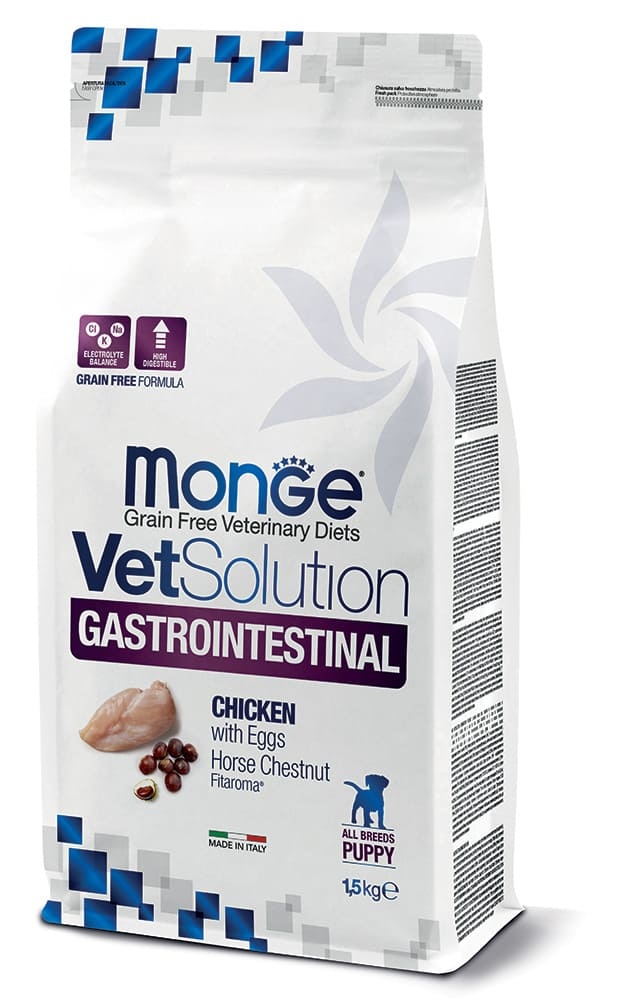
By choosing specialised food such as Monge VetSolution Gastrointestinal, you help a puppy with a sensitive stomach right from the start. Nutrition is the most influential factor in your dog's long-term health.
The different Monge puppy ranges explained
Monge offers various ranges, each with its own focus. The Natural Superpremium range is our classic, high-quality food with chicken or salmon, perfect for balanced growth. It is the ideal choice for owners seeking proven quality and excellent palatability for their dog.
For dogs with a more 'natural' requirement, we offer the BWild range. This food is grain-free or low-grain and often contains a higher meat content, such as duck or venison. This aligns with the dog's instinctive diet and is exceptionally suitable for active puppies requiring energy-dense nutrition.
In addition, there is the Monoprotein range. This is essential for puppies that react sensitively to certain protein sources. By utilising only one animal protein source, such as lamb or salmon, we reduce the likelihood of allergic reactions and food intolerances while still offering a complete meal.
Finally, Gemon offers excellent value for money for daily use. Featuring flavours such as tuna and rice or chicken and rice, Gemon ensures that high-quality nutrition is accessible to every puppy owner, without compromising on the essential nutrients a growing dog requires.
Wet food or dry food: which is better for your puppy?
Many owners wonder whether kibble or wet food is preferable. The answer is often a combination of both. Dry food (kibble) aids dental cleaning through the mechanical action of chewing, whilst wet food (such as our Monoprotein Paté) provides excellent hydration and often higher acceptance among fussy eaters.
Wet food is particularly useful during the first few weeks after weaning, as the texture is soft and easy for a puppy to eat. It is also an excellent way to add extra moisture to your puppy's diet, contributing to healthy kidney function and overall well-being.
At Monge, we often recommend 'mix-feeding'. You can combine the daily portion of kibble with a portion of wet food. This offers the best of both worlds: the dental benefits of kibble alongside the palatability and hydration of wet food. Please ensure you adjust the total daily calorie intake accordingly.
Regardless of your choice, always ensure fresh drinking water is available. Hydration is essential for a growing puppy's metabolism. Our products are formulated to complement one another seamlessly, allowing you to safely vary between our different wet and dry foods.
Feeding schedule: How much and how often?
A puppy has a small stomach but a high energy requirement. Therefore, it is crucial to divide the daily portion into three to four meals per day. This prevents the stomach from becoming overloaded and ensures a steady supply of energy throughout the day.
The exact quantity in grams depends on your puppy's current weight, expected adult weight, and activity level. Always use the feeding guide on the packaging as a guideline, but observe your dog. Is your puppy underweight or overweight? Adjust the portion size in consultation with your vet.
Transitioning to a different food should always be done gradually. Over a period of at least seven days, mix increasing amounts of the new food into the old food. This gives the puppy's digestive system time to adjust to the new ingredients, preventing diarrhoea and other digestive issues.
When should you switch to adult food? This depends on the breed. Small breeds are often fully grown around 10–12 months, whereas large breeds may require junior food up to 18 or even 24 months to ensure optimal skeletal development. If in doubt, always consult our product specifications or a specialist.
Frequently asked questions (FAQ)
- What is the best food for a puppy? The best food is tailored to your puppy's age, breed, and health. Monge offers specialised ranges such as Natural Superpremium for balanced growth.
- How often should a puppy eat? Divide the daily portion into 3 to 4 meals per day to support digestion.
- How many grams of kibble should a puppy have per day? This varies by brand and type of food. Consult the feeding guide on the packaging of your specific Monge product and adjust based on your puppy's weight.
- Can a puppy eat wet food? Yes, wet food is excellent for hydration and palatability. It can be perfectly combined with dry food.
- What is the difference between puppy and junior food? Puppy food focuses on the initial rapid growth phase; junior food supports further development into adulthood, particularly for larger breeds.
- Does a large-breed puppy need different food? Yes, large breeds require a specific calcium-phosphorus balance to prevent growing pains and skeletal issues.
- When should you switch to adult dog food? Usually between 10 and 24 months, depending on the size of the breed.
- How long does it take to transition puppy food? Allow at least one week for this process by gradually mixing the old and new food.